
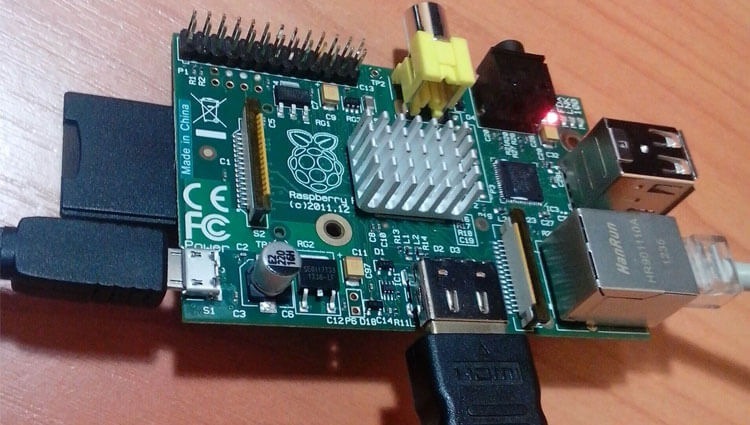
After getting my two Raspberry Pis, after updating the software to the latest versions, I became interested in increasing the CPU speed that comes from the manufacturer without losing warranty.
The only thing I did was put a radiator on a raspberry chip.
It is not clear how fast the Raspberry Pi works, so he checked and laid out for all tests of calculation by a calculator, as well as compression into an archive of mp3 files.
Install the calculator by executing the command:
aptitude install bc
The first calculator test performed the command: time echo "scale=5000; 4*a(1)" | bc -l -q
Two launches at the same frequency.
We will test at these processor frequencies:
700Mhz
800Mhz
900Mhz
950Mhz
1000Mhz
Testing 700Mhz.
First launch:
time echo "scale=5000; 4*a(1)" | bc -l -q
real    4m12.491s
user    4m8.930s
sys     0m0.240s
Second launch:
time echo "scale=5000; 4*a(1)" | bc -l -q

real    4m12.466s
user    4m8.710s
sys     0m0.240s
Testing 800Mhz
First launch:
time echo "scale=5000; 4*a(1)" | bc -l -q

real    3m40.802s
user    3m37.800s
sys     0m0.130s
Second launch:
time echo "scale=5000; 4*a(1)" | bc -l -q

real    3m41.388s
user    3m38.360s
sys     0m0.160s
Testing 900Mhz.
First launch:
time echo "scale=5000; 4*a(1)" | bc -l -q

real    3m17.123s
user    3m14.440s
sys     0m0.230s
Second launch:
time echo "scale=5000; 4*a(1)" | bc -l -q

real    3m17.567s
user    3m14.910s
sys     0m0.160s
Testing 950Mhz
First launch:
time echo "scale=5000; 4*a(1)" | bc -l -q

real    3m6.262s
user    3m3.710s
sys     0m0.180s
Second launch:
time echo "scale=5000; 4*a(1)" | bc -l -q

real    3m6.244s
user    3m3.790s
sys     0m0.180s
Testing 1000Mhz.
First launch:
time echo "scale=5000; 4*a(1)" | bc -l -q

real    2m52.309s
user    2m50.600s
sys     0m0.050s
Second launch:
time echo "scale=5000; 4*a(1)" | bc -l -q

real    2m52.657s
user    2m50.620s
sys     0m0.030s
The second test archives an mp3 file size of 11mb by running the following command: time tar cf - test_archive_pi.mp3 | gzip -c -9 > test_arch_XXXMHz.tgz
Two launches at the same frequency.
We will test at these processor frequencies:
700Mhz
800Mhz
900Mhz
950Mhz
1000Mhz
Testing 700Mhz.
First launch:
time tar cf - test_archive_pi.mp3 | gzip -c -9 > test_arch_700MHz.tgz

real    0m10.756s
user    0m9.660s
sys     0m0.550s
Second launch:
time tar cf - test_archive_pi.mp3 | gzip -c -9 > test_arch_700MHz.tgz

real    0m11.128s
user    0m10.410s
sys     0m0.490s
Testing 800Mhz
First launch:
time tar cf - test_archive_pi.mp3 | gzip -c -9 > test_arch_800MHz.tgz

real    0m10.416s
user    0m9.750s
sys     0m0.490s
Second launch:
time tar cf - test_archive_pi.mp3 | gzip -c -9 > test_arch_800MHz.tgz

real    0m10.538s
user    0m9.860s
sys     0m0.490s
Testing 900Mhz.
First launch:
time tar cf - test_archive_pi.mp3 | gzip -c -9 > test_arch_900MHz.tgz

real    0m11.055s
user    0m9.980s
sys     0m0.490s
Second launch:
time tar cf - test_archive_pi.mp3 | gzip -c -9 > test_arch_900MHz.tgz

real    0m10.897s
user    0m9.820s
sys     0m0.500s
Testing 950Mhz
First launch:
time tar cf - test_archive_pi.mp3 | gzip -c -9 > test_arch_950MHz.tgz

real    0m10.220s
user    0m9.370s
sys     0m0.620s
Second launch:
time tar cf - test_archive_pi.mp3 | gzip -c -9 > test_arch_950MHz.tgz

real    0m10.230s
user    0m9.560s
sys     0m0.490s
Testing 1000Mhz.
First launch:
time tar cf - test_archive_pi.mp3 | gzip -c -9 > test_arch_1000MHz.tgz

real    0m8.402s
user    0m7.550s
sys     0m0.420s
Second launch:
time tar cf - test_archive_pi.mp3 | gzip -c -9 > test_arch_1000MHz.tgz

real    0m8.754s
user    0m7.890s
sys     0m0.390s
Well, a small conclusion after overclocking the Raspberry Pi processor.
On the tests for calculation, the processor showed an increase in performance by almost 2 times, that is, on 700Mhz an average of 4.12 minutes execution, then under acceleration to 1000Mhz already 2.52 minutes, which is faster by 1.6 minutes.
On the file compression test by the archiver, the difference is not so significant, that is, on 700Mhz. an average of 10.8 seconds execution, then under acceleration to 1000Mhz already 8.6 seconds, which is faster by 2.2 seconds. This is not a huge difference, but it is also significant if you count in minutes or hours.
This test is made for yourself, and laid out for public access to familiarization.
I was with you. Sergey Lazarenko.
Let’s take a short break and watch an interesting video how to make a fire to spend the night in the forest in winter:

comment