
 The penetration of the Internet around the world has not yet reached its peak, but in most settlements in Ukraine, the network is available - both wired and wireless. Mobile Internet use is not so convenient yet due to insufficient speed - we only have to dream about 4G, not to mention the very recent penetration of 3G, and literally 2 operators who do not decide on a global uninterrupted provision of permanent Internet access. And that is why wired Internet is still the most common and - what to say - convenient, plus - fast with relative cheapness. On average, the speed is 100 Mbps and no matter how many devices are connected, the speed does not reflect. And if earlier the fastest and most progressive was ADSL-connection, at the moment DOCSIS and FTTB technology are used.
Most often, having a wired connection, people do not limit themselves to a cable, but using a router (also known as a router) - connect their devices conveniently via Wi-Fi. And if the choice of an Internet provider is rather a matter of personal choice (all operators offer in general the same terms and services), then choosing a router requires certain knowledge, which at first glance is simple, and on the other hand, ordinary people actually know little about them.
Ask the first person you meet what a router is in fact - the answer will be, rather, what the Internet provides. The router, in order to already place all the dots above I, is almost a simplified computer - a device with computing capability, "honed" for certain narrow tasks, the so-called network computer. It is equipped with a processor with frequency, RAM - this hardware directly affects its capabilities. This device sends data packets between different segments of the network using the recipient address, which is indicated in the packet header and according to a given algorithm - finds a path in the routing table and sends data there. If there is no data in the table - rejects the transfer. That is, it distributes routes for the transmission of data packets - that's the name. Thanks to the router, you can connect several devices on the grid to the Internet.
Important parameters of the router should be considered the speed of Wi-Fi – that is, how quickly data can be transmitted over a local network between the router and, for example, a smartphone. A weak signal is a weak transmission, and no amount of Internet speed can save you here. Therefore, this characteristic must be taken into account first of all.
The next characteristic of a router is the frequency range. The standard ranges are 2.4 and 5 GHz.
The speed of ports that are needed for ordinary home LAN and WAN purposes is at least 100 Mbps. LAN ports are important if you copy heavy files inside the network, and if the provider provides Internet speeds above 100 Mbit / s, then without a WAN port with a speed of 1000 Mbit / s you can not do. However, starting to choose routers on price.uaPay attention to the types of connection protocols supported: a good router is capable of supporting dynamic IP, static IP, PPPoE, PPTP, L2TP protocols, as well as wireless data standards - IEEE802.11b,g,n,ac.
It is very good if the router has a USB port that will expand the possibilities. For example, use it as a torrent client and without connecting to your computer directly download files to HDD, connect to a TV, connect 3G/4G modems and distribute the Internet over Wi-FI, work as a home or office PBX. GSM gateway and a lot of things.
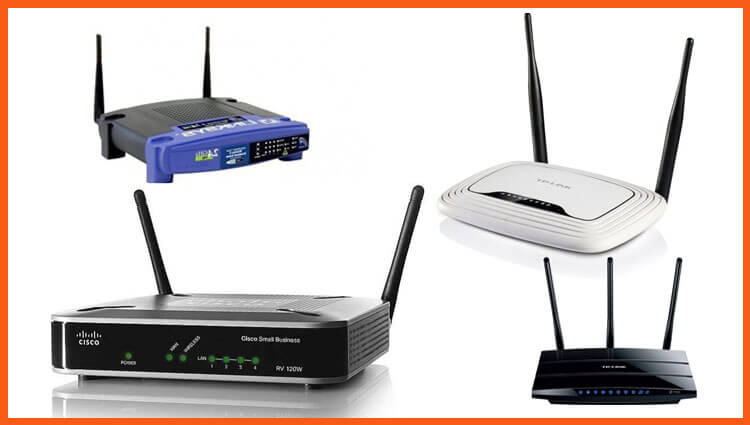
It should also be remembered that the larger the room in which you intend to use the router, the more powerful the device should be - to have antennas. Some get the so-called ripit amplifiers of the router signal, but they immediately reduce the speed of the Internet.
The most common routers among ordinary users have a Wi-Fi connection speed of 150-300 Mbps, most without a USB port. They are generally not bad, but because of the weak “stuffing”, the hardware can hang, so that the user will often have to restart it. But if you have Wi-Fi in your house will extend to literally 3 devices, and the Internet speed is up to 10-40 Mbit / s, then in general, budget routers are quite suitable. And by the way, there are some routers of the budget segment, which proved themselves in work just fine, for example. router DIR-320 Asterisk was installed as a home or office PBX with a GSM modem to save on calls.
If you are fundamentally clean, not "reduced" connection speed, then you should choose a router with a speed of up to 600 Mbit (300+300 Mbit / s), at a frequency of 2.4-5 GHz. These routers usually have 1 or 2 USB ports. These routers in a different price segment, but accordingly, problems with freezing and speed reduction will not arise, for example from this series. router Asus RT-N66U which we flashed in the article, and which I personally use as a home PBX with 3G modem for dialing to my mobile, in work showed itself simply excellent both in speed WIFI and stability of the device in terms of hanging - not noticed and overloaded only when the lights are turned off or when updating the firmware.
In general, when any purchase is advised to look for the selected router customer reviews, as a branded expensive router can show itself from a not very good side, and a budget router can work without hanging and show excellent and stable WIFI speed.

comment