
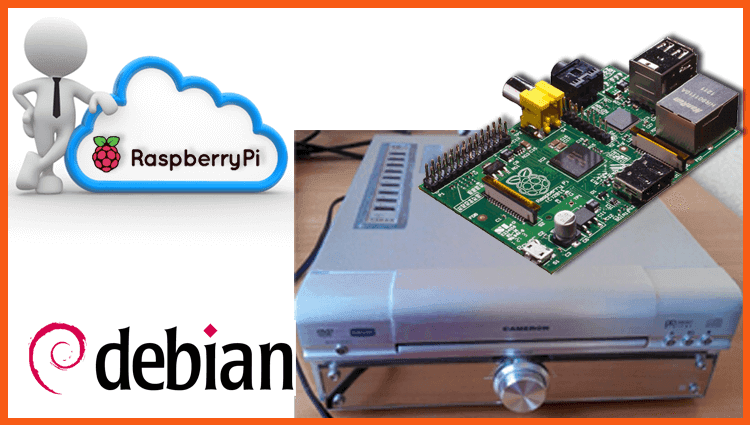
A public photo of one of the enclosures I took for a mini server on a Raspberry Pi single board computer. The body itself is taken from a broken DVD player. If the fee is the size of a credit card, then the case itself is much larger, but since it was necessary to insert an external USB Hub into the case, the size of the cover allowed you to use a hub for 10 ports. Also, the size of the case allowed you to connect a USB pocket with a hard drive of 2.5 inches to connect to the board.
Totally, the most significant disadvantage of the case is a large size, but based on the size there are pluses, this is free space for another hard drive or one or more Raspberry Pi boards if you need to assemble a mini cluster for training, or for hosting your site. In addition, the iron case gives much more peace of mind for fire safety when you go on vacation. The same size of the case allows the air inside to circulate and cool well as a board with glued radiators, and a power supply unit with a hard drive.
Let me warn you that I don’t pretend to be a super corps, but it does its job well.
- The operating system on this mini server is installed according to the instructions: Install Debian on a Raspberry Pi mini server
- Asterisk installed the phone according to this instruction: Installing Asterisk PBX on a Raspberry Pi mini server
- The web server is configured according to this instruction: Installation of Nginx and PHP-FPM web servers on a Raspberry Pi mini server
Here are some photos of the Raspberry Pi mini server in a case from an old DVD player:


Carved a Bulgarian hole under the USB Hub, the hub glued glue Moment:


On the hub glued to the lid of the USB, attempts are seen to glue the hub outside, but in the work the best option to place the hub inside the case has shown itself:

An old USB pocket for the hard drive glued to the case on the same glue Moment dripping around the edges, and smearing heatpaste in the middle of the pocket. So I tried to bring the heat sink from the hard drive to the body, maybe excessively, but there was a thermal paste and still glue my pocket, then why not smear the heat paste:


Winchester also glued to the metal cover of a USB pocket:


He mocked his pocket well, and from time to time (old) he just died and was replaced with a new USB pocket that works further in this case stably and trouble-free:

The power unit took on 2A, pulled out of the case for better heat transfer:


Sticked to the same glue and network outlet RJ-45:

To the power supply soldered plug for power Raspberri Pi and USB hub:

In the assembly, the body looks quite good, in work everything is also great. The only thing you would need to bring to the case of a socket for connecting DVI from Raspberry Pi:


Today, I showed off my home mini server, and this board did a great job with the home telephony load on Asterisk, its cloud using BTSYNC, and its small website.
I’ll post some photos later for the Orange Pi server.
I was with you. Sergey Lazarenko.
Let’s take a short break and watch the video on how to make a snowy igloo:

comment